
Seat Leon >> Tyre life
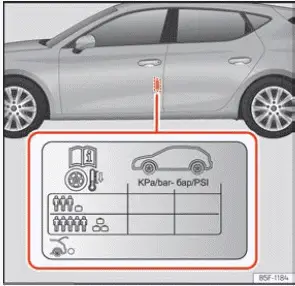
Fig. 244 Location of the tyre pressure sticker.
Maintaining precise inflation pressures alongside smooth, considerate driving habits directly extends the operational life of your tyres while preserving optimal handling characteristics.
- Check cold inflation pressures across all four wheels at least once every month, as well as before embarking on long road trips.
- Always check pressure when the rubber is cold. If you must inspect warm tyres after extended driving, never bleed off air pressure, as natural thermal expansion raises internal pressure temporarily.
- Adjust overall tyre pressure according to the current load being carried by your vehicle ››› Fig. 244.
- If your Seat Leon features a tyre pressure monitoring system (TPMS), remember to recalibrate and store the updated pressure values in the system after adjusting tyre inflation.
- Avoid aggressive cornering, excessive wheelspin, and abrupt acceleration to prevent premature tread degradation.
- Inspect the physical tread area periodically for signs of uneven edge wear, feathering, or localized cupping.
Tyre pressure
Recommended inflation values are detailed on the vehicle specification label attached to the lower rear frame of the front left door pillar ››› Fig. 244.
Driving with under-inflated or over-inflated rubber significantly shortens useful tread life, compromises directional stability, and impairs overall ride comfort. Correct tyre inflation is vital for maintaining braking performance and dynamic safety, particularly when traveling at highway speeds.
Adjust inflation levels whenever passenger occupancy or luggage weight changes. When carrying full payload or heavy cargo, increase cold tyre pressures to match the maximum load rating specified on the door pillar label ››› Fig. 244.
Do not forget to inspect your spare wheel during routine pressure checks. Keep standard-size spares inflated to the maximum inflation pressure recommended for standard road wheels.
If your Seat Leon is equipped with a compact space-saver temporary spare (such as 125/70 R16 or 125/70 R18), maintain it at a constant inflation pressure of 4.2 bar in accordance with the specifications shown on the pressure label ››› Fig. 244.
Driving style
Aggressive cornering, hard standing starts, and heavy braking that induces tyre squeal drastically accelerate tread wear and reduce overall tyre longevity.
Wheel balance
Every wheel assembly fitted at the factory is accurately balanced prior to delivery.
However, road impacts, curb contact, or natural tyre wear over time can induce dynamic imbalance, which typically manifests as noticeable vibrations felt through the steering wheel at speed.
Imbalanced wheels require prompt rebalancing by a technician. Left uncorrected, continuous vibration causes uneven tread wear and places unnecessary strain on front suspension components and steering linkages. Rebalancing is also essential whenever a new tyre is mounted or an existing tyre undergoes repair.
Incorrect wheel alignment
Misaligned running gear or compromised suspension geometry causes rapid, irregular tread scrub, deteriorating road holding and compromising vehicle stability. If you observe uneven edge wear across the tread face, schedule a full wheel alignment check at an authorized SEAT Service Centre.
WARNING Improper care or incorrect handling of wheels and tyres can lead to sudden pressure loss, tread detachment, or dangerous high-speed blowouts.
- The driver bears full responsibility for keeping all vehicle tyres inflated to their correct operational pressures. Exact recommended values for various loading conditions are displayed on the vehicle door label ››› Fig. 244.
- Monitor tyre pressure at frequent intervals to ensure levels remain aligned with factory specifications. Running on severely under-inflated tyres causes excessive heat build-up inside the casing, which can lead to tread delamination or catastrophic tyre failure.
- Pressure readings must strictly match the values listed on the reference label when measured while the tyres are cold ››› Fig. 244.
- Regularly measure cold tyre inflation pressures. Adjust pressures only when the vehicle has been stationary long enough for the tyres to cool completely to ambient air temperature.
- Inspect the tread and sidewalls routinely for cuts, bulges, cracks, embedded objects, or deep structural wear.
- Never exceed the maximum speed rating or maximum load capacity index stamped on the sidewalls of the tyres fitted to your vehicle.
Environmental responsibility
Under-inflated tyres increase rolling resistance, which elevates engine workload and noticeably increases overall fuel consumption.
 New wheels and tyres
It is always best to have all wheels and tyres serviced and inspected by an authorised, specialised workshop. Such professional facilities possess the required technical knowledge, specialised p ...
 Tread wear indicators
Fig. 245 Tyre profile: tread wear indicators.
Fig. 246 Swapping tyres.
Integrated wear indicators measuring approximately 1.6 mm in height are molded into the base of the main tread grooves on o ...
See also:
Checking fluid levels
From time to time, the levels of the different fluids in the
vehicle must be checked. Never fill with incorrect fluids, to do
so may cause serious damage to the engine.
Fig. 184 Diagram for the
...
