
Seat Leon >> Refuelling
Safety warnings regarding fuel handling
WARNING Automotive fuel is extremely flammable and volatile, and mishandling it can result in severe burns, catastrophic fires, and other serious personal injuries.
- Before pulling into a fuel station to refuel your Seat Leon, always ensure that any auxiliary heating system is completely switched off.
- When refuelling your vehicle, always turn off the engine and switch off the ignition completely for essential safety reasons.
- The fuel system on Plug-in Hybrid Electric Vehicle (PHEV) variants of the Seat Leon is pressurized to prevent harmful petrol vapours from escaping into the atmosphere.
- Never smoke or use open flames while filling the fuel tank or handling spare fuel containers. Naked flames and sparks are strictly forbidden anywhere near fuel pumps due to the extreme risk of explosion.
- Always comply fully with local statutory legislation and safety regulations governing the legal use, storage, transport, and carrying of spare fuel canisters inside a motor vehicle.
CAUTION For general safety reasons, SEAT does not recommend carrying a spare emergency fuel canister inside your vehicle.
In the event of a collision or severe accident, a portable fuel canister can be damaged, ruptured, and cause dangerous fuel leaks. If, under exceptional circumstances, you must carry a spare fuel canister, you must observe the following critical safety precautions:
- Never fill a spare fuel canister while it is positioned inside the vehicle cabin or resting on top of body panels. Doing so creates a severe risk of static discharge and explosion. Always place the container flat on the ground outside the vehicle before filling it.
- Insert the fuel pump filling nozzle as far as possible into the opening of the spare fuel canister.
- If the spare fuel canister is manufactured from metal, ensure that the metal filling nozzle maintains continuous physical contact with the container throughout the refuelling process. This bonding contact prevents dangerous electrostatic charge buildups and spark ignition.
- Never spill fuel inside the vehicle interior or within the luggage compartment. Fuel vapours are heavy, highly toxic, and extremely explosive.
There is an immediate risk of a fatal accident!
NOTICE
- If any fuel is accidentally spilled onto the painted bodywork or exterior trim of your Seat Leon, it must be removed and cleaned off immediately. Prolonged contact with fuel can permanently etch or damage the paint finish.
- Never run the fuel tank completely dry until the engine stalls. Operating on an empty fuel system can cause internal damage to the sensitive catalytic converter or particulate filter.
- When refuelling after running the fuel tank completely dry on a Seat Leon equipped with a diesel engine, the ignition must be switched on for at least 30 seconds before attempting to crank the engine.
When you subsequently engage the starter, it may take longer than usual (up to one full minute) for the diesel fuel system to re-prime and for the engine to start firing smoothly.
For the sake of the environment
Never overfill the fuel tank beyond the automatic shut-off point of the pump nozzle. If ambient temperatures rise, expanding fuel can overflow, damaging environmental surfaces and vehicle components.
Note There is no emergency mechanical release mechanism for manually opening the fuel tank filler flap from inside the luggage compartment if electrical power fails. If necessary, request assistance from qualified specialist personnel.
Note Diesel-powered versions of the Seat Leon are equipped with an integrated misfuelling protection device designed to prevent the insertion of an incorrect petrol fuel nozzle. The filler neck will only accept standard diesel pump nozzles.
- If a fuel pump nozzle is excessively worn, damaged, or unusually slender, it may fail to depress and release the internal protective flap mechanism. Before attempting to force or twist the nozzle into the neck, try a different fuel pump at the station or request expert help.
- If you attempt to refuel your vehicle using an emergency reserve fuel canister with a narrow spout, the misfuelling protection flap may not open automatically. One reliable way to overcome this is to pour the fuel in very slowly and steadily.
Refuelling
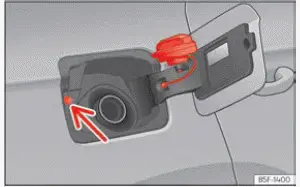
Fig. 209 Fuel tank flap with tank cap
attached.
The fuel tank filler flap is conveniently positioned on the rear right side of your Seat Leon.
- The fuel tank flap unlocks automatically whenever the vehicle is unlocked via the central locking remote control system.
For Plug-in Hybrid Electric Vehicle (PHEV) models: Press the
 button located on the interior trim of the driver's door to electronically release and depressurize the fuel tank system before opening.
- Open the fuel tank filler flap fully by gently pressing on its outer rear retainer zone.
- Unscrew the fuel tank cap by turning it counterclockwise (to the left).
- Place the removed cap neatly into the designated parking space located on the hinge of the open filler flap ››› Fig. 209.
- Begin refuelling your Seat Leon. The fuel tank is completely full as soon as the automatic fuel pump nozzle clicks and cuts off the fuel supply for the first time. Do not attempt to pump additional fuel after the automatic shut-off triggers, as this can overfill the expansion chamber built into the fuel tank.
- Reinstall the fuel cap and screw it securely back on by turning it clockwise (to the right) until it clicks firmly into its locked position.
- Close the outer filler lid until it latches flush.
The correct, authorized fuel grade for your specific engine variant is indicated clearly on an information sticker affixed to the inside of the fuel tank flap. Further important notes regarding fuel quality and specifications can be found within your vehicle literature.
The total fuel tank capacity specifications for your Seat Leon model can be verified in the technical data section.
Hybrid vehicles
On hybrid models, it is necessary at least once every 6 months to drive using petrol combustion power until the dedicated control lamp  switches off on the instrument cluster display, after which the tank must be replenished with fresh fuel. This routine maintenance cycle is necessary to ensure the emission system operates correctly and to maintain the required petrol fuel freshness and quality for hybrid driving modes.
Purging the fuel tank
✓ Valid for: hybrid vehicles
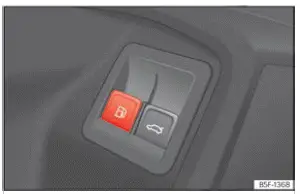
Fig. 210 Driver's door: tank flap release.
Before refuelling a plug-in hybrid Seat Leon, the high-pressure fuel system must be fully depressurized as outlined in the safety warnings regarding fuel handling. To initiate this depressurization sequence, press the  button located on the driver's door panel.
An audible chime will sound, and a corresponding status message or warning notification will appear on the instrument cluster digital display screen.
After a brief waiting period of a few seconds, the fuel tank flap will electronically unlock and remain unlocked for a limited time window. If you do not commence refuelling within this window, you must press the  button again before attempting to open the flap.
Avoid pressing or touching the fuel tank flap lock mechanism or latch button ››› Fig. 209 (arrow) manually while refuelling. The vehicle control system will interpret this action as a signal that refuelling is finished and will terminate the cycle.
If needed, press the  button on the driver's door again to reset and continue your refuelling procedure.

 Fuel types
Identification of fuels
Fig. 211 Identification of fuels according to
European Union (EU) Directive 2014/94/
Automotive fuels are clearly categorized and identified by distinct standardized symbo ...
See also:
Fuel consumption
The consumption and emission details shown on the vehicle data sticker
differ from one vehicle to another.
The figures for fuel consumption and CO2 emissions of the vehicle are also
found on the v ...
