
Seat Leon >> ACC system limitations
The inherent physical boundaries of radar technology mean that the ACC system is not suitable for safe operation in all driving situations ››› refer to Introduction.
SEAT strongly recommends avoiding the use of Adaptive Cruise Control in the following scenarios ››› :
- During torrential rain, heavy snowfalls, or thick fog.
- When driving through enclosed tunnels.
- On stretches of road undergoing active roadworks or construction.
- On winding routes with sharp curves, such as steep mountain passes.
- When driving off-road or on unpaved terrain.
- Inside covered multi-storey car parks.
- On roads featuring embedded metallic objects, such as railway or tram tracks.
- On loose gravel or sandy road surfaces.
Pay exceptional attention and maintain manual control when utilizing ACC in the following specific situations:
On curves
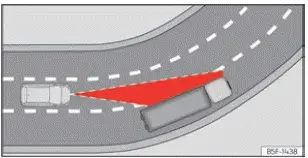
Fig. 139 Vehicle on a bend.
When cornering on a curve, the ACC front radar may temporarily fail to detect the vehicle ahead, or it might incorrectly regulate distance based on vehicles travelling in adjacent lanes ››› Fig. 139.
Vehicles outside the sensor zone
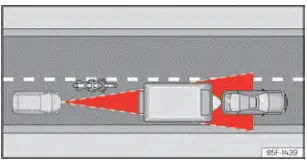
Fig. 140 Motorcyclist ahead out of range of the
radar sensor.
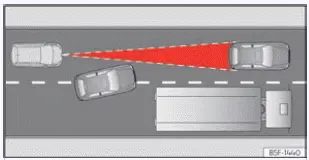
Fig. 141 Vehicle changing lanes.
In the following traffic scenarios, the ACC may fail to react, or its reaction may be delayed or inappropriate:
- Narrow or offset vehicles that are misaligned while driving or positioned outside the direct detection cone of the radar sensor, such as motorcycles ››› Fig. 140.
- Vehicles that swerve or cut into your lane at a very close distance directly in front of your car ››› Fig. 141.
- Vehicles transporting bulky loads or external accessories that protrude dangerously from the sides, rear, or roof.
Objects that are not detected
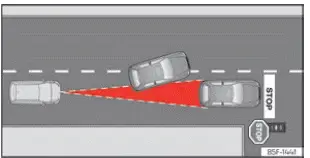
Fig. 142 A vehicle turning and another
stationary.
The ACC function is engineered exclusively to detect and respond to moving vehicles travelling in the same direction ahead of you. Consequently, it cannot detect and will ignore:
- Pedestrians
- Animals
- Vehicles travelling in the opposite direction or crossing your path at intersections.
- Stationary obstacles of any kind
Furthermore, the ACC system may not react reliably to stationary vehicles parked in your path.
If, for instance, a leading vehicle tracked by the ACC turns away or swerves out of the lane and exposes a stationary vehicle hiding behind it, your Seat Leon will not react to that second stationary obstacle automatically ››› Fig. 142.
WARNING Relying on Adaptive Cruise Control in any of the above-listed situations can cause serious traffic accidents, severe injuries, and may constitute a violation of local traffic laws.
 Special driving situations
Fig. 138 On the instrument cluster display: ACC
active, vehicle detected on the left.
Always remain fully aware of the operational limitations and safety warnings described at the beginning of thi ...
 Troubleshooting
ACC not available
The indicator lamp lights up in yellow on the instrument cluster:
The front radar sensor is heavily soiled, blocked with grime, or incorrectly aligned.
Always take th ...
See also:
Assembly overview - microphone unit
Exploded view - Microphone unit , vehicles without anti-theft alarm
- Telephone microphone -
R38-
Removal and installation
- Front interior light - W1-
housing.
- Front interior ...
