
Seat Leon >> Radio-operated remote control
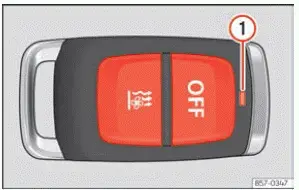
Fig. 118 Auxiliary heating: radio remote
control.
 Switch the auxiliary heater on
 Switch the auxiliary heater off
 Control lamp.
If the buttons on the radio remote control key fob are pressed inadvertently, the auxiliary heater on your Seat Leon may be switched on accidentally, even if you are standing outside the maximum operating range or if the control lamp is flashing.
To reliably switch the independent auxiliary heating on or off, you must press and hold the respective button down firmly for approximately 1 second.
Control lamp on the remote control
Whenever you press the control buttons, the feedback LED control lamp on the remote key 1 gives you distinct visual feedback regarding signal transmission status:
It lights up continuously for approx. 2 seconds
- In green: The auxiliary heater has successfully been
switched on using the
 button.
- In red: The auxiliary heater has successfully been
switched off using the
 button.
Flashes slowly for approx. 2 seconds
- In green: No activation signal was received by the vehicle. The remote control key is out of radio range. Step closer to your Seat Leon and try again.
- In red: No deactivation signal was received by the vehicle. The remote control key is out of radio range. Move closer to the car and try again.
Flashes quickly for approx. 2 seconds
In green: The independent heating system is blocked and cannot be activated.
Possible causes: the main fuel tank is nearly empty, the vehicle's 12-volt onboard battery voltage is dangerously low, or a system fault has been detected.
It lights up for approx. 2 seconds
- In orange (and then turns solid green or solid red): The button cell battery inside the remote control is almost empty.
However, the activation or deactivation signal was successfully received by the vehicle.
- In orange (and then flashes green or red): The button cell battery in the remote control is nearly exhausted.
No activation or deactivation signal was received by the vehicle.
Flashes continuously for around 5 seconds
- In orange: The battery inside the remote control key is completely flat. No activation or deactivation signal could be transmitted to the vehicle.
Changing the battery of the radio-operated remote control
When pressing the remote buttons, if the LED feedback indicator lamp 1 flashes orange for about 5 seconds or fails to light up at all, the internal battery must be replaced promptly.
The battery compartment is situated beneath a removable protective cover located on the rear casing of the remote control.
- To open the protective battery cover, pry it up slightly at the lower notch edge and slide it downward off the remote casing.
- Carefully lift out the discharged button cell battery.
- Insert a fresh replacement battery. When installing the new battery, make sure to observe correct terminal polarity (+/- facing correctly) and use a battery matching the specified type.
- Reattach the battery cover by inserting the retaining tabs into the upper slots first, then pressing the bottom edge down until it snaps securely shut.
Range
The signal receiver unit is installed securely inside the vehicle cabin. When equipped with fresh, fully charged batteries, the radio remote control key fob has a functional operating range of several hundred metres under ideal conditions. However, physical obstacles blocking the path between the remote control and your Seat Leon, adverse weather conditions, sources of radio interference, or weak batteries can considerably reduce the transmission range.
WARNING Swallowing a button cell battery with a diameter of 20 mm or any other coin-sized battery can cause severe internal chemical burns, serious injuries, or even death within a very short period of time.
- Always keep the radio remote control key fob containing internal batteries, as well as spare batteries, button cells, and any other battery units larger than 20 mm, completely out of the reach of children and vulnerable individuals.
- If you suspect or know that someone may have swallowed a battery, seek emergency medical attention and advice immediately.
NOTICE
- The auxiliary heating remote control contains sensitive electronic components. Therefore, avoid exposing the unit to moisture, water immersion, heavy physical impacts, or direct, prolonged sunlight.
- Using unsuitable or non-standard replacement batteries may damage the internal circuitry of the remote control. Always replace an exhausted battery with a new one matching the exact voltage, size, and technical specification.
For the sake of the environment
- Always dispose of used batteries responsibly and in an environmentally friendly manner through designated local recycling collection points.
- The button cell battery inside the remote control may contain perchlorate material. Please observe all applicable local legal provisions and regulations regarding its safe disposal.
- Take care when handling and storing the remote control to ensure it is not possible to activate the buttons unintentionally, which could result in switching on the auxiliary heating system by mistake without your knowledge.
Programming the auxiliary heater
Setting up the auxiliary heating or parking ventilation system for a scheduled departure time is valid exclusively for a single operating cycle. A new departure time must be programmed manually for each subsequent heating or ventilation process.
Before attempting to program any departure times, you must verify that the internal clock date and time settings of your Seat Leon are correctly configured.
When you program a departure time, the vehicle's electronic control unit automatically calculates the required operating duration of the auxiliary heating system based on prevailing outside environmental and temperature conditions.
WARNING Never program or allow the auxiliary heating system to switch on and operate in enclosed, tightly sealed, or unventilated spaces such as a garage or indoor parking bay. The exhaust gases produced by auxiliary heating contain carbon monoxide—a highly toxic, colorless, and odorless gas. Inhaling carbon monoxide causes rapid loss of consciousness, asphyxiation, and death.
 Switching the auxiliary heater on and
off
Connection
The fuel-powered auxiliary heating system on your Seat Leon can be switched on using any of the following methods:
Press the instant on/off activation button within the My
SEAT ...
 Usage instructions
The auxiliary heater exhaust system located beneath your Seat Leon must be kept clear of snow, mud, leaves, and other potential obstructions at all times. The exhaust fumes must be able to escape free ...
See also:
Changing the front windscreen wiper blades
If the windscreen wiper blades are in perfect condition, you
will benefit from an improved visibility. Damaged wiper
blades should be replaced immediately.
Fig. 148 Changing the
front wiper blad ...
