
Seat Leon >> Correct sitting position of vehicle occupants
Correct position on the seat
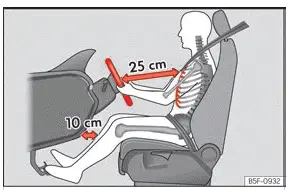
Fig. 16 The correct distance between the
driver and the steering wheel must be at least
25 cm (10 inches).
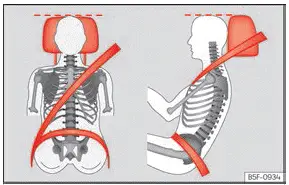
Fig. 17 Correct belt web and headrest
positions
The correct seating positions for both the driver and all passengers inside your Seat Leon are detailed below to ensure maximum occupant protection.
If your physical condition or health requirements prevent you from maintaining the standard recommended sitting posture, contact a specialized technical workshop for guidance on suitable special adaptations or equipment options. The integrated seat belts and supplemental restraint airbags can only provide optimum protection during a collision if a correct sitting position is adopted by every individual in the cabin. SEAT recommends taking your car in for professional technical service when modifications are necessary.
To enhance personal safety and significantly reduce the risk of injury during an accident, emergency braking maneuver, or sudden evasive action, SEAT strongly advises adhering to the following positioning guidelines:
Valid for all vehicle occupants:
- Adjust the seat head restraint so that its upper edge is aligned, as closely as possible, with the top of your head and near eye level. Keep the back of your neck positioned as close to the cushioned headrest as possible ››› Fig. 17.
- Occupants of shorter stature must fully lower the headrest, even if the top of the head remains below the restraint's upper edge.
- Taller occupants must fully raise the headrest to its highest lockable position.
- Always keep both feet planted flat in the footwell while the vehicle is in motion.
- Properly adjust and securely fasten your seat belt across your lap and shoulder before moving off.
The following also applies to the driver:
- Angle the seat backrest to an almost upright position so that your back rests completely and comfortably against the seat back.
- Adjust the steering wheel column so that the center of the wheel maintains a clear distance of at least 25 cm (10 inches) from your sternum ››› Fig. 16, ensuring you can grip the rim securely with both hands on the outer sides while keeping your arms slightly bent.
- Ensure the steering wheel hub is always pointed toward your chest and never aligned directly toward your face.
- Adjust the seat's longitudinal position so you can depress all foot pedals fully to the floor with your knees slightly flexed, maintaining a minimum clearance of 10 cm (4 inches) between your knees and the lower instrument panel ››› Fig. 17.
- Set the overall seat height so that you can easily reach the very top of the steering wheel rim while maintaining full view of the road and instrument cluster.
- Always keep both feet situated in the driver's footwell area to retain full vehicle control over the pedals at all times.
For the passenger, the following applies:
- Move the passenger seat backrest to an almost upright posture so that your back makes complete contact with the seat cushion backrest.
- Slide the front passenger seat as far back as reasonably possible, maintaining a strict minimum clearance of 25 cm between your chest and the dashboard instrument cluster. If you sit closer than 25 cm, the front passenger airbag system will be unable to protect you properly during deployment.
Number of seats
The standard passenger cabin of your Seat Leon is engineered with 5 individual seating positions: 2 seats in the front row and 3 seats across the rear bench. Every designated seating position comes equipped with its own dedicated three-point safety belt.
Always check the official registration documents for your vehicle to confirm the exact approved occupant capacity limit specified for your model variant.
WARNING Adopting an incorrect sitting position significantly elevates the risk of sustaining severe or fatal injuries during sudden emergency braking, rapid collision avoidance maneuvers, crashes, or upon explosive airbag deployment.
- Before starting your Seat Leon, all vehicle occupants must assume an ergonomically correct seating posture and maintain it continuously throughout the entire journey. This requirement applies equally to the proper positioning and fastening of safety belts.
- The maximum number of people permitted to travel inside the vehicle must never exceed the total count of seats equipped with operational seat belts.
- When transporting children, always secure them using an officially approved child restraint system suited specifically to their weight, age, and physical height.
- While driving, keep both feet planted securely in the footwell at all times. Never rest your feet on the seat cushion, against the dashboard panel, or extend them outside an open window. Deviating from a proper posture prevents the safety belt and airbag systems from offering adequate protection, drastically increasing injury severity in an accident.
Risks of sitting in an incorrect position
If seat belts are routed improperly or omitted altogether, the likelihood of critical or fatal injury in a collision increases dramatically. Seat belts can deliver optimal restraint only when the webbing is positioned precisely across the body's skeletal framework. Incorrect sitting postures substantially degrade the protective physics of safety belts, exposing occupants to extreme forces. This risk of severe physical trauma is heightened even further if a deploying supplemental airbag strikes a passenger who is positioned out of alignment with designed safety zones. The vehicle driver carries ultimate legal and operational responsibility for the safety of everyone onboard, particularly young children.
The following list outlines specific examples of improper sitting positions that create immediate dangers for all occupants inside your Seat Leon.
When the vehicle is in motion:
- Never stand up inside the vehicle cabin.
- Never stand on top of the seat cushions.
- Never kneel on the seats facing forward or backward.
- Never recline your seat backrest excessively far to the rear while traveling.
- Never lean forward against the front dashboard panel.
- Never lie down flat across the rear seat bench.
- Never perch on the front edge of a seat cushion.
- Never sit turned sideways in your seat.
- Never lean your head or body out of an open side window.
- Never extend your feet or legs out of a vehicle window.
- Never rest your feet on top of the front dashboard panel.
- Never place your feet on the seat bench cushion or against the seat backrest.
- Never ride or crouch inside a footwell area.
- Never sit or rest your weight on center or door armrests.
- Never travel without properly buckling your seat belt.
- Never carry passengers inside the rear luggage compartment.
WARNING Remaining in an incorrect sitting posture greatly increases the danger of severe or fatal injuries in collisions, emergency evasive maneuvers, or sudden hard braking.
- All passengers inside your Seat Leon must maintain proper seating posture throughout the trip and wear their seat belt correctly fastened across the chest and lap.
- Occupants who fail to sit upright, neglect seat belt usage, or position themselves too close to airbag housing covers risk suffering life-threatening injuries when deploying airbags inflate at high speed.
 Safe driving
Safety first!
WARNING
This comprehensive vehicle manual contains vital operational information concerning the safe usage of your Seat Leon, designed to protect both the driver and all vehicle ...
 Seat belts
...
See also:
Dismantling and assembling drive shaft
Dismantling and assembling drive shaft, constant velocity joint VL100
Special tools and workshop
equipment required
Tightening plate - VW 401-
Tightening plate - VW 402-
Die - VW 408 A-
Di ...
