
Seat Leon >> Introduction
The Travel Assist function intelligently combines Adaptive Cruise Control (ACC) and the adaptive lane guidance system to provide advanced, semi-automated driving support on your Seat Leon.
Within the inherent technical limitations of the system, your Seat Leon can maintain a safe following distance from the vehicle ahead preselected by the driver while continuously remaining in the preferred centring position within the driving lane.
Travel Assist relies on the exact same sensor architecture, optical cameras, and radar technology utilized independently by Adaptive Cruise Control (ACC) and Lane Assist.
Therefore, it is essential to read all technical information regarding both ACC and Lane Assist carefully, keeping all system limitations and operational warnings detailed in those chapters in mind.
How to know if the vehicle is fitted with Travel Assist
Your vehicle is equipped with Travel Assist if the dedicated Travel Assist configuration option appears inside the instrument cluster menu when the appropriate button on the multifunction steering wheel is pressed.
Speed range
The Travel Assist system actively regulates vehicle speed and steering guidance smoothly across an operating range between 20 and 210 km/h (15 and 130 mph).
Driving with Travel Assist
Travel Assist takes over automated control of the accelerator pedal, the braking system, and the steering wheel. Furthermore, within its system boundaries, Travel Assist can decelerate your Seat Leon all the way to a complete standstill behind a stopping lead vehicle, and then automatically pull away and resume driving again when traffic moves.
You can override assisted adjustment and steering control manually at any time with minimal effort.
Status display
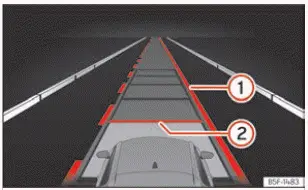
Fig. 145 On the instrument cluster display:
display of active regulation (schematic
representation).
- The colour of the digital lane markings indicates the operational status of the adaptive lane guidance function:
- Green: adaptive lane guidance function is active and steering guidance is engaged.
- Grey: adaptive lane guidance function is in a passive standby state.
- Preselected following distance level indicator.
- Always bear all system limitations and operational indications regarding Adaptive Cruise Control (ACC) and Lane Assist firmly in mind.
- Always adapt your driving speed and safety following distance relative to the vehicle ahead to suit prevailing visibility, weather conditions, road surface quality, and traffic flow.
- Do not use Travel Assist when visibility is severely impaired, on steep mountainous roads, on winding curvy routes, on slippery surfaces (such as packed snow, black ice, heavy rain, or loose gravel), or when driving through flooded road sections.
- Never use Travel Assist off-road, on unpaved dirt tracks, or on roads without a firm, solid surface. Travel Assist has been designed exclusively for use on paved public roads.
- Travel Assist does not detect or react to pedestrians, animals, or vehicles crossing your path laterally, nor to vehicles approaching you head-on in the same lane.
- Apply the service brakes immediately if Travel Assist fails to decelerate the vehicle with sufficient force.
- Brake immediately whenever a prompt to intervene appears on the instrument cluster display, or if Travel Assist does not reduce travel speed sufficiently.
- Apply the foot brake if your Seat Leon continues to move forward involuntarily after a braking instruction has been issued.
- Avoid wearing thick gloves while driving if possible.
The capacitive steering wheel sensors could misinterpret gloved hands as a lack of driver steering activity.
- If a driver intervention request appears on the instrument cluster display, immediately resume full manual control of the vehicle.
- Always keep your hands on the steering wheel rim at all times to ensure you maintain permanent physical control over vehicle steering. The driver always bears sole legal responsibility for keeping the vehicle safely in its own lane.
- Always remain fully prepared to adjust your speed manually at a moment's notice.
Depending on your vehicle's specific equipment level, supplementary details—such as broken road markings and surrounding vehicles ahead—can also be rendered on the digital instrument cluster display screen.
Control lamps clearly indicate the overall system status on the instrument cluster display:
 Indicator lamp green: Travel Assist is active, and both adaptive cruise control and adaptive lane guidance functions are fully operational.
 Partially green lamp: Travel Assist is active, with adaptive cruise control actively regulating while the adaptive lane guidance function is in a passive state.
 Grey lamp: Travel Assist is deactivated and not currently regulating speed or steering.
Driver intervention prompt
If you remove your hands from the steering wheel for an extended period, after a few seconds the system will prompt you to take over steering control via a clear visual notification on the instrument cluster display accompanied by distinct audible warning chimes.
If you fail to react to these repeated warnings, Travel Assist will automatically deactivate itself.
Depending on optional equipment fitted to your Seat Leon, Emergency Assist will then activate in its place to bring the vehicle safely to a halt.
WARNING The smart technology powering Travel Assist cannot defy or overcome the limits imposed by the unyielding laws of physics and operates strictly within established system boundaries. If Travel Assist is used negligently, distractedly, or involuntarily, it can cause severe traffic accidents and personal injuries. This assistant system is never a replacement for continuous driver awareness and concentration.
 Travel Assist
...
 Operating Travel Assist
Fig. 146 Left side of the multifunction steering
wheel
Switch on and start regulation
The Travel Assist function is activated directly via the driver assistance selection menu shown on the instru ...
See also:
The danger of not using the seat belt
Many people believe that the occupants can protect themselves
with their hands in a minor collision, this is false.
Fig. 8 A driver not
wearing a seat belt is
thrown forward violently.
Fig. 9 ...
