
Seat Leon >> Safety instructions
Valid for: hybrid vehicles
DANGER The high-voltage electrical network and lithium-ion traction battery in your plug-in hybrid Seat Leon present severe electrical hazards that can cause serious chemical burns, tissue damage, and fatal electric shocks.
- Always treat the high-voltage battery system as if it were fully charged and completely live under all circumstances. Dangerous electrical potentials remain present within the system even when the vehicle ignition is switched completely off.
- Never touch high-voltage cables, the high-voltage battery housing, or exposed terminal poles, and prevent them from coming into direct contact with jewelry, rings, tools, or other metallic objects—particularly if the cables, battery casing, or terminals show any signs of physical damage.
- Never attempt to perform any type of inspection, diagnostic test, or repair work on the vehicle's high-voltage electrical network, high-voltage wiring harnesses, or the traction battery yourself.
- Never open, dismantle, modify, or perform unauthorized maintenance on any components of the high-voltage circuit, nor attempt to disconnect wiring harnesses from the high-voltage network.
- Never damage, alter, strip, or remove the distinct orange-colored high-voltage cables, and never disconnect them from the high-voltage distribution network.
- Never open, puncture, modify, or remove the protective security cover from the high-voltage traction battery pack.
- All technical work, diagnostics, and repairs carried out on the high-voltage system—or on any surrounding vehicle systems indirectly influenced by it—must be executed exclusively by certified specialist personnel possessing the required high-voltage safety qualifications and professional training.
- Performing work in the immediate vicinity of high-voltage cables and live electrical components using sharp instruments, tools that produce metal shavings, or equipment generating intense heat sources (such as hot air guns, thermal bonding tools, or welding apparatus) is strictly prohibited unless the high-voltage system has been professionally isolated and de-energized.
System de-energization and voltage disconnection must be performed exclusively by certified specialist personnel with appropriate technical qualifications and training.
- All official SEAT service guidelines, safety standards, and technical protocols must be strictly followed when performing any authorized work on the high-voltage electrical architecture and traction battery of your Seat Leon.
- Chemical gases vented, emitted, or leaking from a damaged high-voltage battery pack can be highly toxic, corrosive, or flammable.
- Physical impact damage to the vehicle body or the high-voltage battery can cause an immediate or delayed release of hazardous toxic vapors. These emitted gases carry a severe risk of fire or chemical ignition. Never inhale any vapors escaping from the battery system.
- Never touch or come into contact with any electrolyte liquids spilling from a damaged high-voltage battery pack, and avoid inhaling any released vapors or gases.
- In the event of a vehicle fire involving a hybrid model, immediately evacuate the danger area and contact the fire department without delay.
- Always explicitly inform responding firefighters and emergency rescue personnel that the vehicle involved is a plug-in hybrid equipped with a high-voltage battery system.
DANGER Performing unauthorized, amateur, or inappropriate maintenance work on the high-voltage system and its sensitive electronic components can lead to catastrophic system faults, severe accidents, and fatal physical injuries.
- All service and repair work on the high-voltage network must be performed strictly by authorized specialist service centers holding the appropriate official high-voltage clearance permits.
NOTICE If your Seat Leon suffers an accident, severe bottom impact, or collision with a road obstacle, the high-voltage traction battery and safety circuits must be inspected thoroughly by certified specialist personnel with specific high-voltage training before the vehicle is driven again.
NOTICE If the 12-volt auxiliary vehicle battery has been disconnected, drained completely, or replaced with a new unit, the internal combustion engine may temporarily fail to shut off automatically when coming to a stop immediately after moving off. If this operational anomaly persists for several days, contact an authorized specialist workshop for system recalibration.
SEAT strongly recommends visiting an authorized SEAT partner for all inspection and maintenance procedures.
High voltage warning lettering
Valid for: hybrid vehicles
Warning lettering on the vehicle
The following areas and components of your hybrid Seat Leon are explicitly identified with high-voltage warning labels ››› Fig. 51, ››› Fig. 52, ››› Fig. 53 , ››› Fig. 54:
- Covers, shields, and access lids housing live high-voltage components beneath them.
- All high-voltage power system components, including the main high-voltage traction battery assembly.
- Engine compartment locations situated directly under the front bonnet.
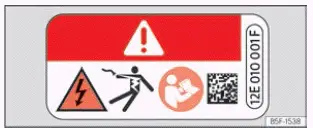
Fig. 51 Warning lettering.
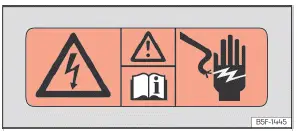
Fig. 52 Warning lettering.
The high-voltage warning labels ››› Fig. 51 and ››› Fig. 52 indicate the immediate presence of dangerous electrical voltage.
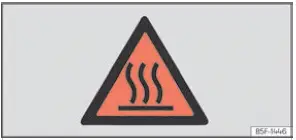
Fig. 53 Warning lettering.
Components comprising the high-voltage system can reach elevated operating temperatures during use and should never be touched directly with bare hands ››› Fig. 53.
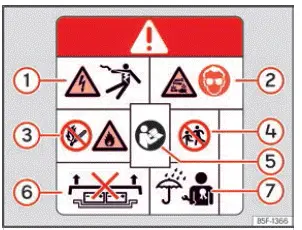
Fig. 54 High-voltage battery warning lettering.
- Exposure to high voltage can inflict catastrophic physical injuries or fatal electrical shock. Never bridge or touch the battery terminal poles with uninsulated fingers, hand tools, jewelry, or metallic items.
- The high-voltage battery unit contains corrosive liquid chemical electrolytes and toxic solid compounds. Vented gases or chemical emissions can cause severe tissue burns, respiratory distress, and permanent loss of sight.
Certified eye protection and full protective safety apparel must be worn whenever handling or working near the high-voltage battery to prevent electrolyte contact with skin and eyes. Should battery fluid accidentally touch skin or eyes, flush the affected body areas continuously with clean running water for no less than 15 minutes, and seek immediate emergency medical treatment.
- The high-voltage battery presents a potential fire hazard under extreme conditions. Under no circumstances should the battery pack be exposed to open flames, thermal sources, or electrical sparks. Handle the high-voltage battery casing with extreme care during service to prevent physical housing damage and electrolyte fluid leaks.
- Keep the high-voltage battery unit and detached system components far out of the reach of children at all times.
- Refer to the owner manual documentation and official factory workshop manuals for detailed safety protocols and technical procedures.
- Improper handling or unauthorized tampering with the high-voltage battery can result in lethal electrical shock or severe injuries.
Never attempt to dismantle, open, or unbolt the protective structural cover of the high-voltage battery pack.
- Routine maintenance and service on the high-voltage battery system must be performed exclusively by qualified specialist technicians holding official high-voltage certifications. Never alter or modify high-voltage battery circuitry. When the battery module is open during certified workshop procedures, ensure that water or conductive liquids never enter the housing.
Ingress of liquids can trigger direct electrical short circuits, high-current arcing, severe burns, and catastrophic battery damage.

 Conservation of the high-voltage battery
Conservation instructions
Valid for: hybrid vehicles
Reliability and capacity of the high-voltage
battery
In principle, lithium-ion batteries are subject to chemical aging and mechanical wear thro ...
See also:
Removing and installing front trim panel for sliding sunroof
Special tools and workshop
equipment required
Electric cutter - SAT
1561A-
Knife 207 - SAT 1561/12-
Cartridge heater - VAG
1939A-
Pull handle - VAG 1351/1-
(x2)
Window sealant pisto ...
